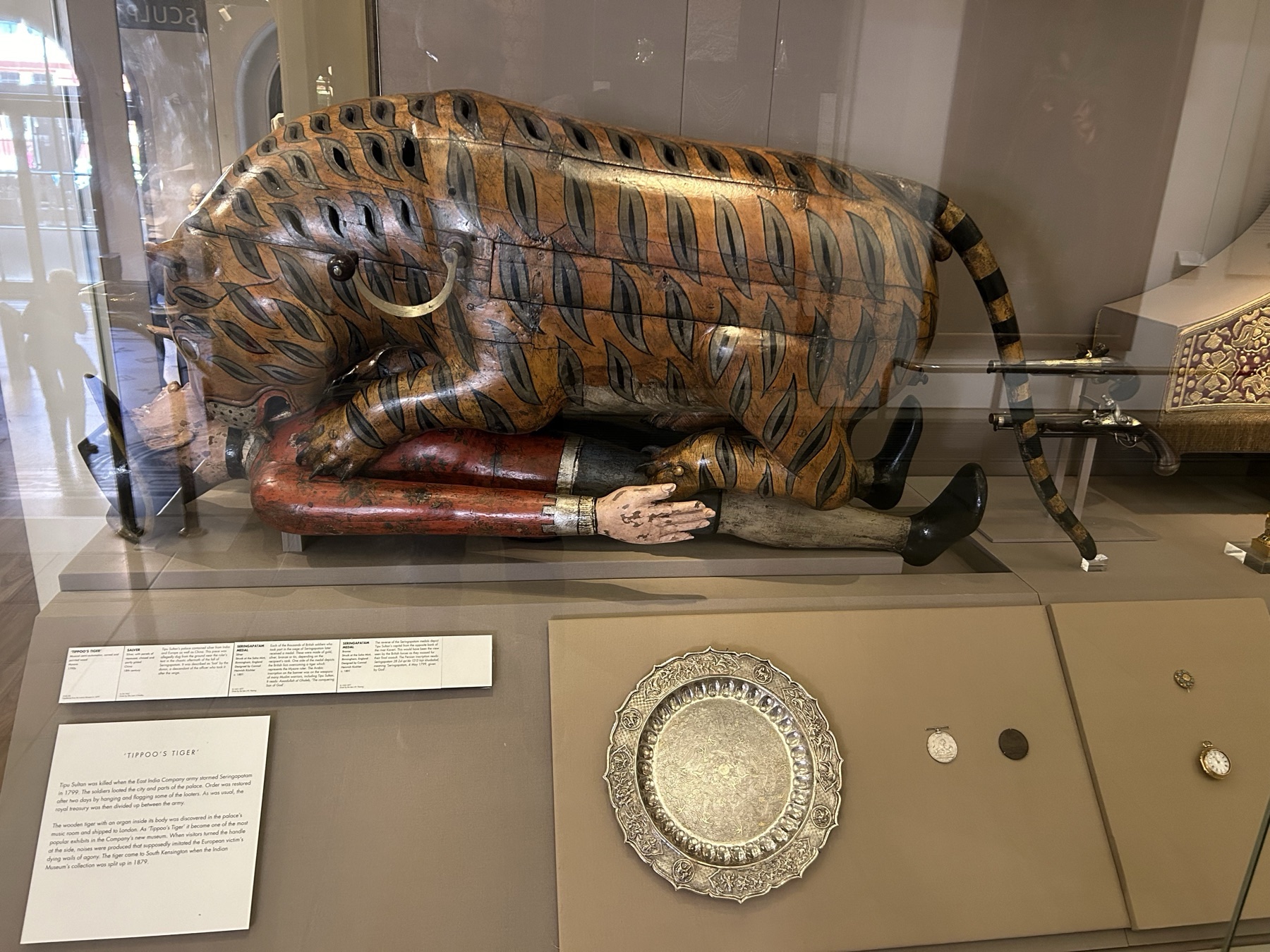
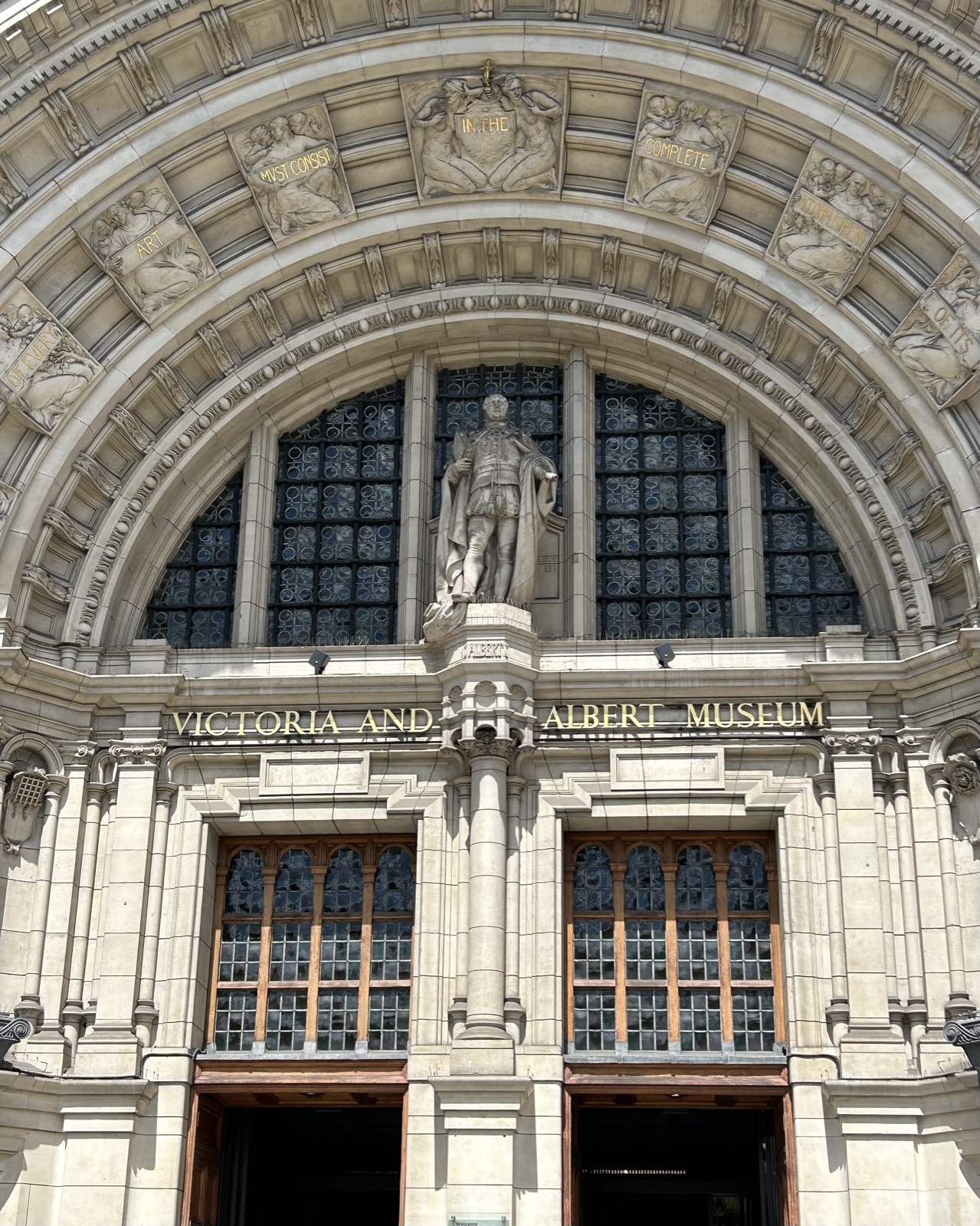
In the summer of 2024 I stood in front of Tipu Sultan’s tiger at the Victoria and Albert Museum.
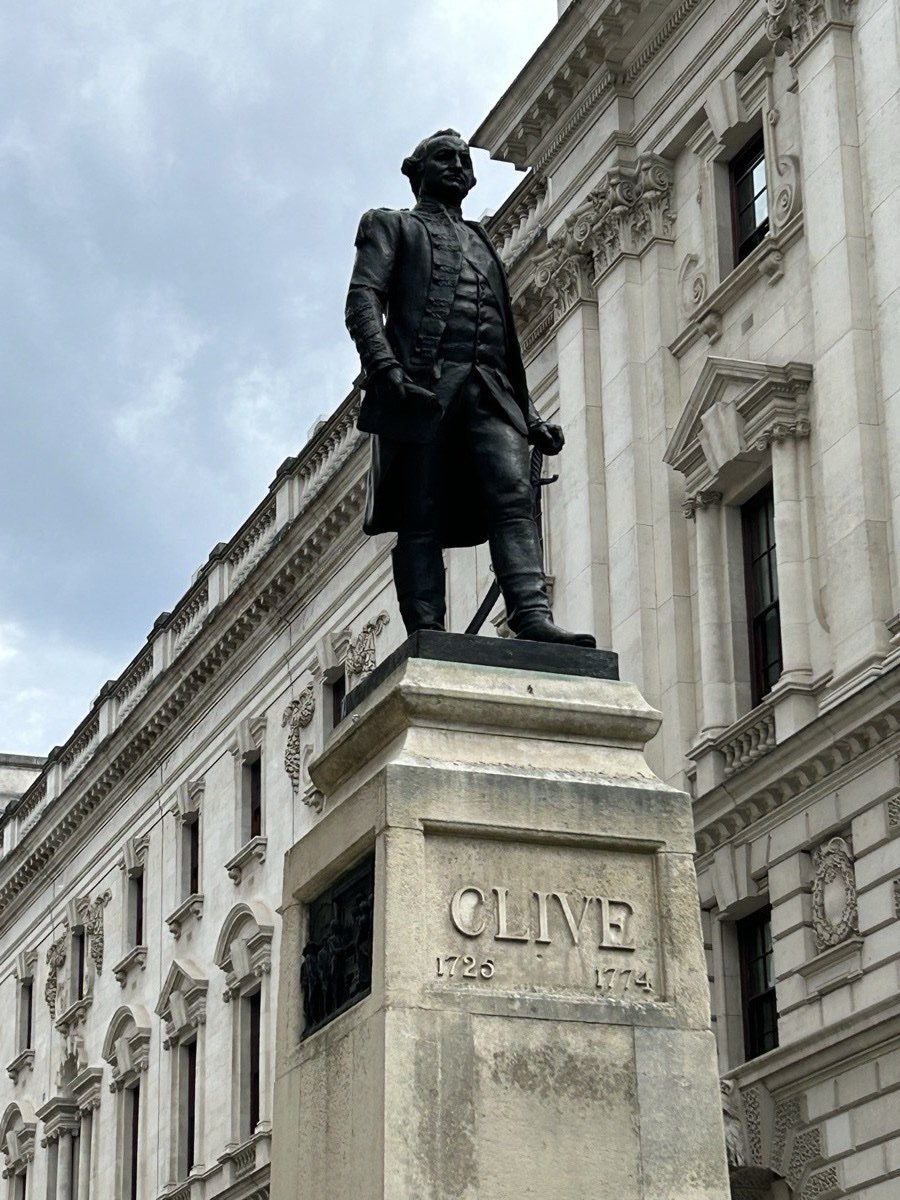
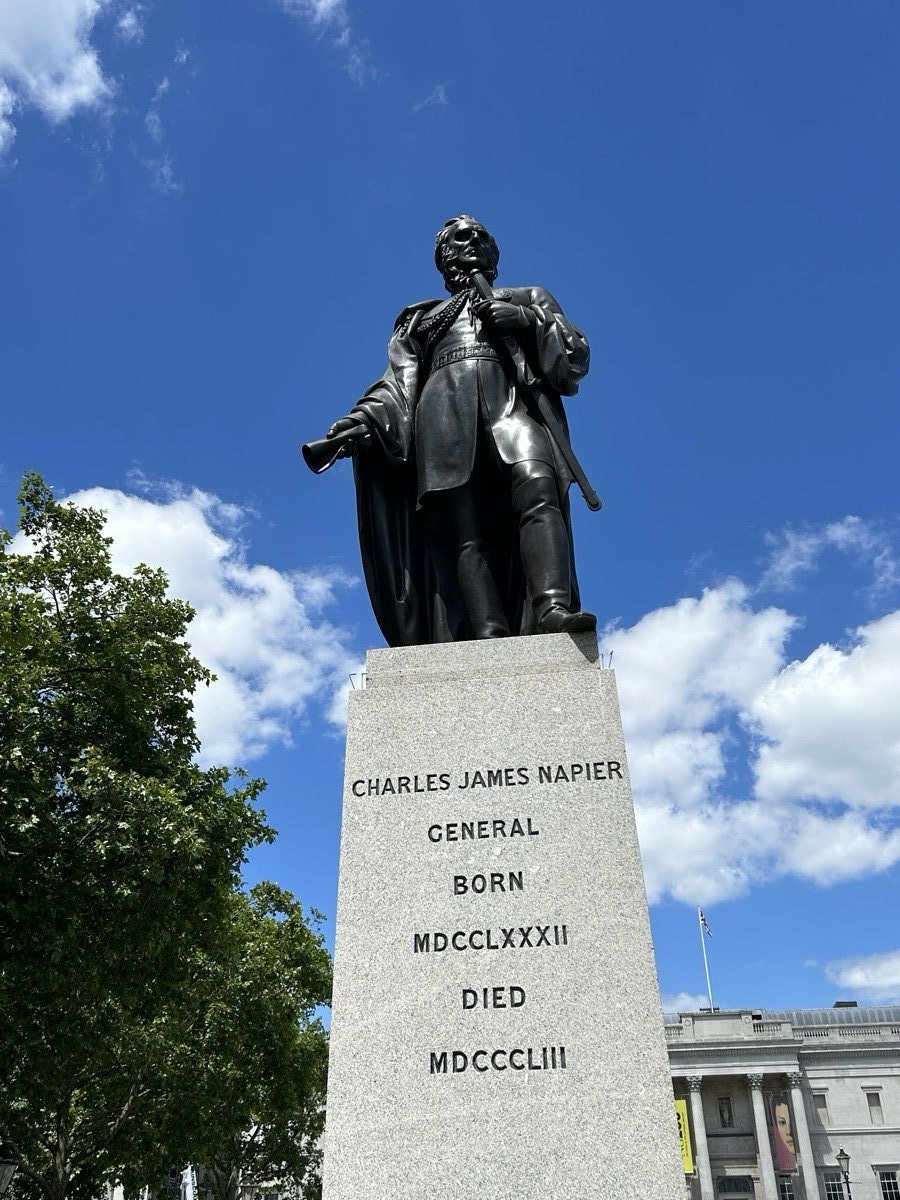
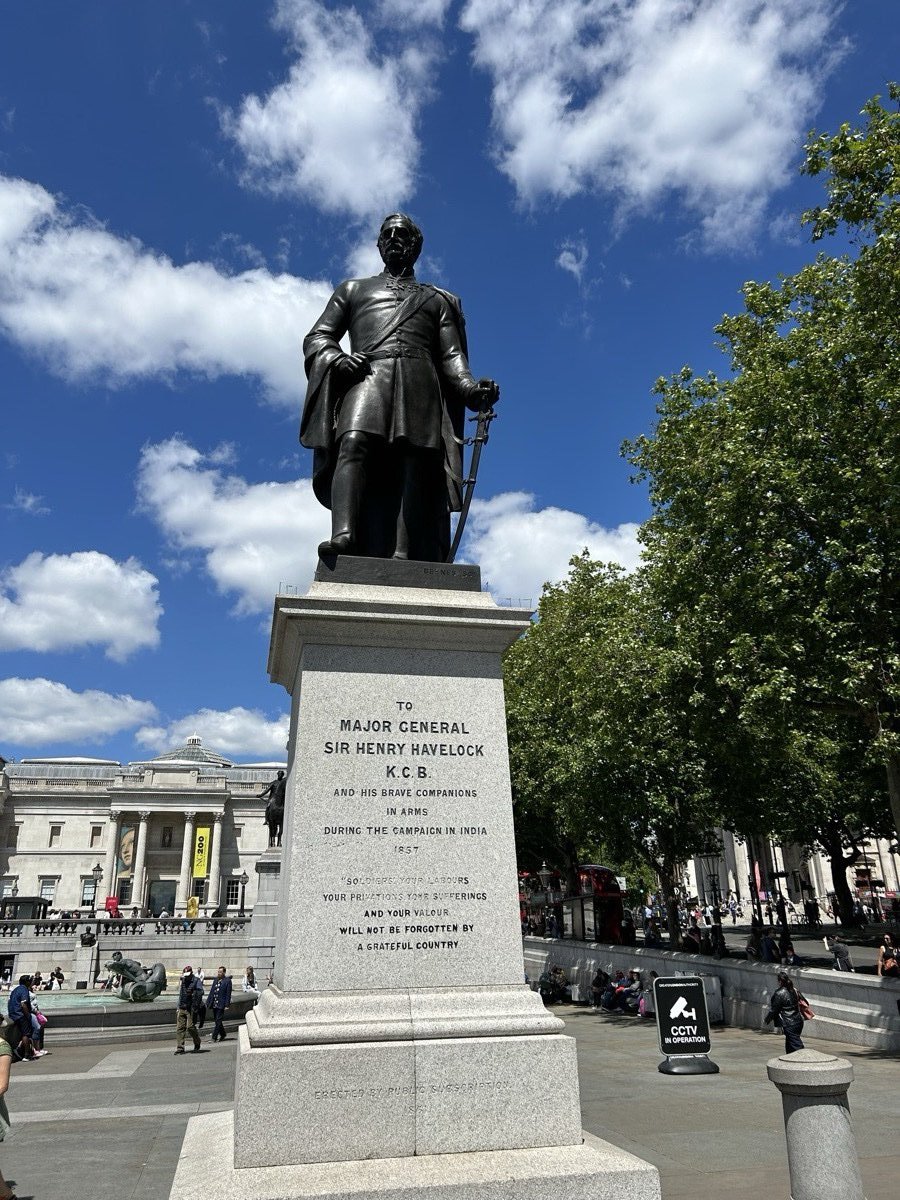
The day before I had walked through Trafalgar Square and looked at the bronze of Major General Sir Henry Havelock, who had led the relief of Lucknow in 1857, and at the bronze of Sir Charles Napier, who had conquered Sindh in 1843. On the way back through Whitehall I had stopped at the statue of Robert Clive on King Charles Street, behind the Foreign Office. Three British generals in bronze, three hinges of the conquest, all standing within a half-mile of each other in central London. I had come to South Kensington the next morning to look at the other side of the glass.
It is a wooden tiger, life-sized, mauling a red-coated European soldier laid on his back. There is an organ inside it. Turn a crank and the soldier’s arm rises and falls and a pipe in his throat makes a moaning sound. The tiger grunts. It has been 225 years since the British soldiers who pulled it out of Tipu’s music room on 4 May 1799 first turned the crank to hear it work. They had just spent an hour finding Tipu’s body under a heap of dead at the Water Gate of his palace at Seringapatam. The tiger has been in London ever since.
I took a picture, the way one does, and thought about what an object 225 years old is doing in a museum in South Kensington.
This essay is the answer.
The question it answers is older than the tiger. Between the death of Aurangzeb in March 1707 and the trial of Bahadur Shah Zafar in March 1858, the Indian subcontinent had no single sovereign for 150 years. The Mughal empire was visibly hollow by 1719. Several powers had a real chance to refound it. The Marathas under Baji Rao I and Sadashivrao Bhau. Tipu Sultan of Mysore. Ranjit Singh’s Sikh kingdom. The rebels of 1857, who briefly held territory the size of France. None succeeded. By 1858 a chartered London joint-stock company that had begun the period with a clerk’s establishment in three coastal factories ruled or controlled almost every inch of land between the Khyber and Cape Comorin.
How?
Every Indian schoolchild gets a four-sentence answer: the British were better organized, the Indians were divided, technology, betrayal, fate. Each of those four sentences is true, and none of them is the answer. The answer, as far as the academic literature of the last thirty years can tell us, is that India was not conquered. India was institutionally asphyxiated, slowly, over a century, by an organization that possessed six advantages no Indian power assembled in time. The argument of this essay is that the failure was structural, not contingent. The mystery is not who killed the empire. The mystery is why every promising successor was checked at the moment of apparent triumph.
I am going to tell that mystery in five acts, because there were five moments when it could have gone the other way. Each act is anchored to a physical object that outlived its owners and is, for the most part, still extant: the Peacock Throne, the Koh-i-Noor, Tipu’s tiger, the Red Fort, and the grave of Bahadur Shah Zafar in Rangoon. The objects are the witnesses. The argument is the detective work.
A note on method. This is not a work of original archival research. It is an essay by an engineer who has spent a quarter-century managing engineers and reading history in his spare time and while testing the next Kindle. It is also a piece I wrote in collaboration with Claude, an AI assistant from Anthropic. The thesis, the structure, the choice of the five objects as witnesses, the personal frame, the counterfactuals, the leadership-and-strategy lens, the editorial cuts, the fact-checking pass, and the final wording of every paragraph are mine. The research scaffolding, surveying the academic literature on each act, hunting for primary-source scenes, drafting most sentences from my direction, weaving the citations, was Claude’s. I am still figuring out what this collaboration is for and what its limits are. This essay is part of my figuring out. I have leaned on the scholarship of Sir Jadunath Sarkar, M. Athar Ali, Irfan Habib, Muzaffar Alam, Stewart Gordon, T. S. Shejwalkar, C. A. Bayly, Tirthankar Roy, John Brewer, Sushil Chaudhuri, Randolf Cooper, Eric Stokes, Rudrangshu Mukherjee, William Dalrymple, and Audrey Truschke, among others. Where they disagree, I have flagged the disagreement. The bibliography is for anyone who wants to read further. The opinions are mine. So are the errors.
The story begins with a man stitching prayer caps in a tent.
The Empty Throne
In the winter of 1706–07 Aurangzeb Alamgir was eighty-eight years old and dying. He had been campaigning in the Deccan for almost twenty years against the Marathas, and the army had not won. He was carried in a litter from camp to camp. His tent was small and unornamented, by his order. He stitched prayer caps with his own hands, sold them anonymously through an attendant, and put the rupees aside to pay for his shroud. The accumulation came, by the time of his death, to four rupees and two annas. He kept it, by instruction in his will, with Aia Bega, the mahaldar, and specified that the amount be spent on the shroud “of this helpless creature.”
On the night of 2 March 1707 he dictated his last two letters. The first was to Azam Shah, his second son, who was in Gujarat. The second was to Kam Bakhsh, his youngest, who was in Bijapur. The letters survive in the Ahkam-i-Alamgiri and the related collections. They are among the most quoted documents in the history of Mughal collapse. To Azam he wrote, in Sir Jadunath Sarkar’s translation:
Old age is arrived: weakness subdues me, and strength has forsaken all my members. I came a stranger into this world, and a stranger I depart. I know nothing of myself, what I am, and for what I am destined. I have not done well by the country or its people, and of the future there is no hope.
To Kam Bakhsh he wrote: Soul of my soul. Now I am going alone. I grieve for your helplessness, but what is the use? Every torment that I have inflicted, every sin that I have committed, every wrong that I have done, I carry the consequences with me. Strange that I came with nothing into the world, and now go away with this stupendous caravan of sin.
He died at noon on 3 March. Per his order, he was buried in the open air beside the dargah of Shaikh Zainuddin at Khuldabad, near Aurangabad in the Deccan. The grave is a slab of red stone, three yards by two, hollow in the centre so the rain and sky fall directly on the earth. No dome. No inscription. Cost: four rupees, two annas. Herbs growing out of his chest.
This is how the most expansionist sovereign in the dynasty’s history paid for his own funeral. The detail is in Khafi Khan’s Muntakhab-ul-Lubab and in Saqi Mustaid Khan’s official chronicle, the Ma’asir-i-Alamgiri. Audrey Truschke, in Aurangzeb: The Life and Legacy of India’s Most Controversial King (Stanford 2017), reads it as evidence that Aurangzeb himself believed he had failed God and the people. Sarkar, writing in the 1930s, called Aurangzeb’s life “one long tragedy, the story of a man battling in vain against an invisible but inexorable Fate.” Neither historian is sentimental about the man. Both note that he saw what was coming.
What was coming was a war of succession that began within months, and a structural unraveling that the empire never recovered from.
Aurangzeb had not formally named a crown prince. Mughal custom was takht ya takhta, throne or coffin, and successions were always contested. But the contest after 1707 was unusually destructive. At the Battle of Jajau on 20 June 1707, south of Agra in the monsoon heat, Bahadur Shah I, the new style of the former Prince Muazzam, age sixty-three, destroyed Azam Shah. Azam and two of his sons were killed in the field. Their bodies were carried by elephants to Humayun’s Tomb. Eighteen months later, in January 1709, Bahadur Shah defeated and killed Kam Bakhsh outside Hyderabad.
Bahadur Shah himself was already an old man at accession. He died on the night of 27–28 February 1712, in Lahore, of an enlarged spleen. He had ruled for just under five years and spent most of them dealing with the Sikh rebellion under Banda Singh Bahadur. The empire’s central authority, in those five years, drifted.
What followed is one of the most extraordinary stretches of dynastic collapse in any major early-modern empire. Between February 1712 and September 1719, the Mughal throne passed through six emperors. Four of them in 1719 alone. Six men, in seven years, in one chair.
The mechanism was a pair of brothers, Sayyid Hussain Ali Khan Barha and Sayyid Abdullah Khan, generals from a Shia Sayyid clan in the upper Doab. They were what Tudor historians would have called overmighty subjects, and what Indian historians have called kingmakers. They appointed and deposed emperors at will. They installed Farrukhsiyar in January 1713 after a battle outside Agra. He was thirty when he became emperor; he would rule for six years. In 1717, in a moment that would shape Indian history more than he could have known, Farrukhsiyar issued a farman exempting the East India Company from customs duties in Bengal, in gratitude for the cure of a painful and dangerous tumour in his groin by an English surgeon named William Hamilton, attached to John Surman’s embassy of 1715. Robert Clive later called the document the “Magna Carta of the Company.”
On the night of 27–28 February 1719, the Sayyid brothers’ troops broke into the Red Fort. Farrukhsiyar was sleeping in the harem when they came for him. He was dragged out, held down on the marble of the Diwan-i-Khas, and blinded. Kamwar Khan’s Tazkirat-us-Salatin Chaghta, written by a man who was in Delhi that night, records the gist. Farrukhsiyar was kept in a cell, beaten, paraded for three weeks, and on the night of 27–28 April 1719 strangled with a bowstring. He was thirty-five. He was the first reigning Mughal emperor to be murdered in his own palace.
The Sayyids installed Rafi-ud-Darajat, who lasted three months and died of tuberculosis. They installed Rafi-ud-Daulah, who lasted three months and died of consumption. They installed the seventeen-year-old Muhammad Shah, who would prove more durable than they had reckoned, and who in October 1720 had Hussain Ali Khan stabbed to death in his own palanquin by a young assassin who pretended to deliver a petition. Hussain Ali’s fourteen-year-old nephew Sayyid Nurallah hacked the assassin to pieces on the spot before being cut down himself.
Six emperors in seven years. Three murdered. One blinded. Two dead of consumption. The institution of Mughal sovereignty had ceased to function. The empire still existed as a fiscal apparatus and a court. But the takht had stopped being inviolable. Once an emperor can be blinded, anyone can be.
Why did this happen? The academic literature on Mughal decline divides, broadly, into three schools, and a working understanding of the period requires holding all three in mind at once.
The first is the Aligarh school, associated with Irfan Habib and M. Athar Ali. Habib’s The Agrarian System of Mughal India 1556–1707 (Asia Publishing House, 1963; revised OUP 1999) is the foundational text. Habib calculated that Mughal land-revenue demand under Aurangzeb crept upward from one-third to as much as half of net produce. The system became extractive to the point of triggering peasant revolt. Habib treated the Jat risings under Gokula (1669) and Rajaram (1685–88), the Satnami rebellion at Narnaul (1672), and the Sikh and Maratha movements as a combined attack of zamindars and peasants against Mughal extraction, not as communal uprisings. M. Athar Ali’s 1975 Modern Asian Studies essay, “The Passing of Empire: The Mughal Case,” argued the empire dissolved because its noble class roughly doubled in size during Aurangzeb’s reign without a corresponding expansion of revenue-yielding jagirs. Once the Deccan was absorbed and its Maratha and Deccani elites enrolled in the mansabdari system, the supply of productive land ran out. The Mughal system became, in essence, a Ponzi scheme of land assignments. Ali’s later work added a technological argument: peasant access to handguns and rockets had eroded the cavalry monopoly of empire by 1700.
The second school is Karen Leonard’s “Great Firm” theory, published in Comparative Studies in Society and History in 1979. Leonard’s argument is that the indigenous banking houses, particularly the Jagat Seth family of Murshidabad, were structurally indispensable to the Mughal nobility’s working capital. When the bankers progressively withdrew credit from imperial faction-leaders after 1700 and redirected it to regional governors and, eventually, to the East India Company, the empire’s machinery seized up. The thesis has been challenged by John F. Richards and more recently by Sudev Sheth, who argue the bankers’ role was overdrawn for the seventeenth century. For the eighteenth, the evidence is unambiguous: the Jagat Seths bankrolled the Plassey conspiracy in 1757, and they did so because they had concluded the Mughal system would not pay its debts.
The third school is the revisionists, led by Muzaffar Alam in The Crisis of Empire in Mughal North India: Awadh and the Punjab 1707–48 (OUP, 1986), reinforced by C. A. Bayly’s Rulers, Townsmen and Bazaars (Cambridge, 1983). Alam argued the eighteenth century was not collapse but devolution. In Awadh under Saadat Khan and Safdar Jung, in Bengal under Murshid Quli Khan and Alivardi Khan, in Hyderabad under Asaf Jah, in the Punjab under the Sikh misls, de facto sovereignty migrated to the regional capitals. Many of the new orders were, by Alam’s measure, more productive than the imperial center had been. Sanjay Subrahmanyam, in “The Mughal State, Structure or Process?” in IESHR 29:3 (1992), pushed back against the strong revisionist line, insisting the system really did fracture in ways the regions could not paper over. The revisionist view, with its insistence on regional vitality, is now the dominant academic frame.
What all three schools agree on is that the structural decay was visible to contemporaries by the 1720s, and that by 1739 the empire was hollow.
Nadir Shah was the man who proved it.
Nadir was a Turcoman shepherd boy from Khorasan who had risen, through three decades of unrelenting military success, to become Shah of Persia. By 1738 he had unified Iran and his ambitions had turned east. The proximate cause of his Indian campaign was a dispute over Afghan refugees: tribes loyal to Nadir had fled across the Khyber after his Kandahar campaign, and the Mughals had refused to expel them. The real cause was simpler. The Mughal treasury was famously rich and notoriously undefended.
He crossed the Indus at Attock in December 1738. He took Lahore in January. He met the Mughal army at Karnal on 24 February 1739. The Mughal army’s deployed field force was roughly 75,000 men out of a camp of perhaps three hundred thousand, with 2,000 war elephants and 3,000 cannons. Nadir had perhaps 55,000 mounted troops. The battle lasted, by Persian timing, the interval between the Zuhar and Asr prayers, under three hours. Saadat Khan, the Nawab of Awadh, was captured atop his elephant. Khan-i-Dauran, the imperial wazir, was shot through the face and died days later. Nizam-ul-Mulk, the empire’s most capable surviving general, stood inactive throughout the day, watching the army die. Sarkar’s verdict: “Ten to twelve thousands of the regular soldiery had fallen on the field of Karnal.”
Two days later, on 26 February, Muhammad Shah was escorted to Nadir’s camp. The two emperors sat on cushions together. They ate from the same plate. Nadir, by Persian custom, suggested they exchange turbans as a gesture of fraternity, and Muhammad Shah, who had hidden the Koh-i-Noor in his turban, had no choice but to comply. The story is treated sceptically by Sarkar. What is not disputed is that Nadir entered Delhi on 20 March 1739, was lodged in Shahjahanabad, and had the Friday khutba read in his name.
On the night of 21 March a rumour spread that Nadir had been assassinated. Delhi’s mobs attacked Persian soldiers in the Paharganj market. Roughly three thousand Persians were killed before dawn. At sunrise on 22 March, Nadir rode through Chandni Chowk with an escort. He climbed the steps of the Sunehri Masjid, the small gold-domed mosque that still stands above the bazaar next to the Kotwali, drew his sword, and gave the order for qatl-i-amm. General slaughter. For six hours, his troops killed.
The eyewitness account is by a Mughal munshi named Anand Ram Mukhlis, who walked through the streets of Delhi afterwards. His Tazkira contains the most quoted lines in eighteenth-century Indo-Persian historiography:
Here and there some opposition was offered, but in most places people were butchered unresistingly. The Persians laid violent hands on everything and everybody; cloth, jewels, dishes of gold and silver, were all acceptable spoil. For a long time, the streets remained strewn with corpses, as the walks of a garden with dead leaves and flowers. The town was reduced to ashes.
Estimates of the dead vary. Mukhlis writes of twenty to thirty thousand. Abdul Karim Kashmiri’s Bayan-i-Waqai corroborates. The killing took six hours. Muhammad Shah eventually fell at Nadir’s feet and asked him, in the words attributed to the moment by Persian chroniclers, to sheath his sword: there was no one left to kill. Nadir sheathed it.
He stayed in Delhi for fifty-seven days. When he left, he took with him the Peacock Throne, which Shah Jahan had commissioned in 1635 and François Bernier had valued at four crores in the 1660s. He took the Koh-i-Noor, the Darya-i-Noor, the Akbar Shah and the Great Mughal diamonds, the Timur Ruby. A thousand elephants, seven thousand horses, ten thousand camels. An aggregate of plunder so vast, somewhere between thirty and seventy crore rupees, depending on the chronicler, that on his return to Persia he suspended all taxation for three years.
Eight years later, on the night of 19–20 June 1747, Nadir was assassinated in his sleep at Fathabad in Khurasan by a conspiracy of his own bodyguard officers. His nephew Ali Quli had the Peacock Throne broken up for the jewels. The pieces scattered across Central Asia and the Caucasus. The Peacock Throne now displayed in Tehran is a nineteenth-century replacement.
The Koh-i-Noor entered a longer journey that would, by 1849, end in a velvet case in Windsor.
Sarkar’s verdict on Nadir’s invasion has not been improved on. “It broke a spell,” he wrote. “It revealed to the world a fact long accomplished, that the Mughal Empire was dying.”
The Mughal sovereignty existed, in form, for another 119 years. As a working political institution, it ended on the steps of the Sunehri Masjid on the morning of 22 March 1739.
The question after that was who would replace it.
The Maratha Bid
The most plausible answer to that question, for almost half a century, was the Marathas.
Shivaji’s swarajya in the Western Ghats had been a thorn in Aurangzeb’s side for three decades. His grandson Shahu was released from Mughal captivity in May 1707 as part of Bahadur Shah’s succession maneuvering. Within fifteen years the Maratha confederacy was projecting cavalry across the subcontinent.
The administrative architecture is, in retrospect, the most interesting thing about it. Shahu delegated executive authority to a hereditary Brahmin chief minister, the Peshwa, beginning with Balaji Vishwanath Bhat in 1713. The Marathas extracted, by formal firmans from the Sayyid Brothers in 1719, the right to levy chauth, one-fourth of revenue, and sardeshmukhi, an additional one-tenth, across the six Mughal subahs of the Deccan. Chauth was a tax on existence: pay us, and we will not raid your villages. By the 1730s it had been converted, in Stewart Gordon’s analysis (The Marathas 1600–1818, New Cambridge History of India, 1993), into a quasi-regular revenue base. G. S. Sardesai’s New History of the Marathas (1946–48) estimated chauth accounted for roughly 45 per cent of Maratha revenue by 1740.
Baji Rao I became Peshwa in 1720, just shy of twenty. Maratha tradition, recorded in the bakhars, gives him a credo to Shahu when accepting the office: let us strike at the trunk of the withering tree, and the branches will fall of themselves. Listen but to my counsel, and I will plant the Maratha banner on the walls of Attock. Shahu’s reply: By heaven, you shall plant it on the Himalayas. The exchange is not from a state document, but it captures the operational philosophy. Baji Rao moved cavalry across India at speeds that left contemporary chroniclers groping for language. At Palkhed in February 1728, by Field-Marshal Bernard Montgomery’s later assessment in A History of Warfare (1968), he produced “a masterpiece of strategic mobility.” His army travelled without artillery, without baggage, without firearms, purely mounted, armed with sabre lance and shield, supplying itself by looting. In March 1737 he marched from his camp to the outskirts of Delhi in roughly forty-eight hours, appeared at Talkatora outside the city walls on 28 March, routed the imperial guard, and withdrew. The Mughal court did not know a Maratha army was on its doorstep until the dust appeared.
By 1740 Maratha cavalry had crossed the Narmada, the Tapti, the Chambal, the Yamuna. They were collecting chauth from Awadh, from Bundelkhand, from Malwa, from the Doab. After Baji Rao’s death in 1740 (age thirty-nine, near the Narmada), his son Balaji Baji Rao continued the expansion. By 1758 a Maratha army under his cousin Raghunathrao had taken Lahore. The Marathas were, in the technical sense the Mughals had been, paramount.
The trouble was that the confederacy was governed, in Gordon’s phrase, by “tribute-takers, not administrators.” Outside Maharashtra the Marathas had no Mughal daftar, no codified land record, no central treasury, no judicial system other than that of the local rulers they were taxing. They had Holkar, Sindia, Bhonsle, Gaekwad, four great sardar houses, each with its own treasury, its own French officers in the next generation, its own rivalries. The Peshwa, in Pune, was primus inter pares, not sovereign.
This was the structural condition under which the Marathas marched north for Panipat.
The proximate trigger was Ahmad Shah Abdali, the Afghan founder of the Durrani Empire, who had been raiding north India since 1748. His fifth invasion, in 1759, was summoned by the Rohillas, the Nawab of Awadh, and the Sufi reformer Shah Waliullah, who wrote to Abdali (the letter survives) appealing for him to come and restore Mughal Islam in the face of Maratha incursion. The Marathas had also given Abdali a casus belli of their own: in January 1760, Najib-ud-Daula and the Rohillas had killed Dattaji Sindia at Burari Ghat. Peshwa Balaji Baji Rao dispatched a vast army northwards under his cousin Sadashivrao Bhau, with the Peshwa’s seventeen-year-old son Vishwasrao as nominal heir-commander.
The forces, reconciled across Gordon, Sardesai, and T. S. Shejwalkar’s Panipat 1761 (Deccan College, 1946):
The Marathas had approximately 55,000 cavalry, 9,000 musketeer infantry under Ibrahim Khan Gardi (a French-pattern infantry corps, an organisational innovation), 150 to 200 modern French-pattern artillery pieces, and approximately 200,000 non-combatants, because Bhau had combined the campaign with a Hindu pilgrimage and the soldiers’ families and the priests and the pilgrims had come along.
Abdali had approximately 41,800 Afghan cavalry, 32,000 Rohilla infantry, and 2,000 zamburak camel-mounted swivel cannons.
Bhau took Kunjpura in October 1760. Abdali outmaneuvered him by crossing the Yamuna in late October and cutting Maratha communications. By December the Maratha camp at Panipat was starving. Suraj Mal of Bharatpur, the Jat ruler, advised Bhau to abandon his artillery and revert to ganimi kava, the Maratha guerrilla tradition. Bhau, by Kashiraj Pandit’s eyewitness account, replied that this would be dishonourable. Suraj Mal withdrew. So did, eventually, several of his other allies.
On 14 January 1761, Makar Sankranti, the Marathas came out at dawn. They advanced in gol formation, a tight compact mass behind Ibrahim Khan Gardi’s massed artillery. The musketeers opened with crushing volleys; they killed an estimated 12,000 Rohillas in the first three hours. Through midday the Marathas were winning. Bhau and Vishwasrao rode on a single elephant in the centre.
Then, around 2 p.m., Vishwasrao was shot through the head by a musket-ball.
Kashiraj Pandit, who was on the Afghan side as diwan to Shuja-ud-Daulah of Awadh, watched from a few hundred yards. His account, written within months and translated into English by James Browne in 1788, is the single most cited eyewitness chronicle:
Between two and three o’clock, Biswas Row was wounded, and dismounted from his horse; which being reported to the Bhow, he ordered them to take him up and place him upon his elephant.
Bhau dismounted from his howdah to lead the charge himself. The empty howdah, the visible symbol of command, the thing the army looked up at to know the army still had a centre, was misread by the Maratha right and rear as Bhau’s death. The line began to dissolve. Abdali, who had held a reserve of 15,000 cavalry through the morning, released them precisely at this moment.
By nightfall, 60,000 Marathas were dead in the field. Bhau himself fought on, three horses shot under him in succession, and disappeared. Kashiraj recorded that he walked across the field at dawn the next morning and identified Bhau’s body from a torn part of an ear-ring. The Afghans massacred 40,000 Maratha prisoners in cold blood the day after. Total Maratha dead, soldiers and non-combatants, exceeded 100,000.
The news reached Pune two weeks later. By Maratha tradition, recorded in the bakhars and by Sardesai, a moneylender’s courier was apprehended on the road, carrying a coded note for the Peshwa: Two Pearls have been dissolved, twenty-seven Gold Mohurs have been lost, and of Silver and Copper, the total cannot be cast up.
The two pearls were Bhau and Vishwasrao. The twenty-seven gold mohurs were the principal Maratha sardars. The silver and copper was the army.
Peshwa Balaji Baji Rao decoded the message, understood it, and died of grief on 23 June 1761.
Could the Marathas have won Panipat?
Tactically, yes. Until 2 p.m. they were winning. If Vishwasrao had not been hit, or if Bhau had stayed in the howdah, or if the right wing had held its nerve, the day could have gone the other way.
If they had won, would they have unified India?
This is the question every counterfactual historian of the period has been forced to answer, and the answer is, with rare unanimity, no.
Gordon, in The Marathas 1600–1818, makes the structural case. Maratha governance was thin. The confederacy could expand indefinitely but could not deepen. Chauth was a tribute, not a tax, and the system fostered a federal structure that could not produce executive command. Shejwalkar, in Panipat 1761, made it politically: the Marathas had no unified war aim. Bhau “was totally ignorant of the political and military situation in North India.” Shejwalkar’s famous conclusion: Had Shivaji’s ideas and ideals been properly understood and followed by his successors, there would have been no occasion for a Panipat in 1761. C. A. Bayly, in Indian Society and the Making of the British Empire (Cambridge 1988), goes further. Even without Panipat, he wrote, the rise of the East India Company under Clive after Plassey (which had already happened in 1757, the Marathas were marching north as the Company was consolidating Bengal) and the bureaucratization of Bengal revenue under the Diwani (which would follow in 1765) would have ground the Maratha confederacy down eventually.
This is the first of the structural verdicts that this essay will keep returning to. Charismatic founders build powerful states. Few of those states survive two successions intact. The Marathas survived two, Shahu, then Baji Rao I, then Balaji Baji Rao, and were destroyed in the third generation, by their own confederal architecture. Panipat was the failure to deepen. The empty howdah was the symbol. The two pearls dissolved was the eulogy.
Four years before the field at Panipat, and twelve hundred kilometres east, in a mango grove on the Bhagirathi river outside the Bengali village of Palashi, Robert Clive had defeated Siraj-ud-Daulah. The Maratha army that died at Panipat had ridden across India to claim an empire that, in some other corner they had not been paying attention to, had already been claimed by someone else.
The Quiet Company
The British East India Company was, in 1707, when Aurangzeb died, a trading firm with three coastal factories at Madras, Bombay, and Calcutta. It was financially unimpressive. It paid 8 per cent dividends in good years and missed them in bad. Its principal business was importing cotton textiles, indigo, and saltpetre into London.
By 1818 it ruled the subcontinent.
The transformation is the subject of more academic literature than any other event in modern Indian history. The recent consensus, which I am going to track through three episodes, is that the Company won not because of military or technological superiority but because of an institutional cluster, credit, capital markets, intelligence, and the ability to be a state without paying the costs of being a state, that no Indian power matched.
The first episode is Plassey, 23 June 1757.
The standard account is that Robert Clive, with roughly 3,100 men, 613 European infantry, 2,100 sepoys, and smaller detachments of artillerymen, sailors, and Eurasian topasses, defeated Siraj-ud-Daulah’s Bengal army of roughly 50,000 in a single afternoon, with 27 British dead. This is true, but it is not the story. The story is that the battle ratified a treaty that had been signed three weeks earlier in Calcutta.
The conspiracy was assembled between April and June 1757. Its principals were the Jagat Seth bankers (the Murshidabad firm of Mahtab Rai and Maharaja Swarup Chand), Mir Jafar Ali Khan (Siraj’s paymaster and senior commander), Rai Durlabh (the diwan), Yar Lutuf Khan, and the Sikh merchant Amir Chand, known to the English as Omichund. The contract, signed on 4 June 1757, promised Mir Jafar the throne of Bengal in exchange for the Company’s expenses (17.7 million rupees as compensation for the previous sack of Calcutta by Siraj, of a treaty restitution totalling some 22 million), the zamindari of the 24 Parganas, and a vast donative for the senior officers. Clive personally received over £234,000, perhaps £30 to £40 million today.
The most lurid moment of the conspiracy was the deception of Omichund, who at the eleventh hour demanded an additional 5 per cent of the Bengal treasury or he would expose the plot. Clive had two treaties drawn: a “white” treaty without Omichund’s clause, signed by all the principals; and a “red” treaty containing it, intended to be shown to Omichund and then discarded. Admiral Watson, the senior Royal Navy officer in Bengal, refused to sign the false one. Clive had Watson’s signature forged. He admitted this in his testimony before the Parliamentary Select Committee on 10 May 1773, defending it as necessary to “save the lives of these people, and secure success to the intended event.”
The battle itself unfolded around a brief monsoon shower at noon, which drenched Siraj’s artillery, the British had tarpaulined theirs, and led Siraj’s loyal commander Mir Madan, who assumed the Company’s powder was equally wet, to launch a cavalry charge into grapeshot from dry British guns. He was killed by a roundshot. By a famous passage in Ghulam Hussain Khan’s Seir Mutaqherin, the great Persian eyewitness chronicle of the period, written c. 1781 by a cousin of Alivardi Khan, Siraj took off his turban and laid it at Mir Jafar’s feet, begging him to defend it. Mir Jafar replied with reassuring words and did nothing.
By evening Siraj had fled toward Murshidabad on a camel. He was captured nine days later at Rajmahal, where he was recognised by a dervish whose ears he had once cut off in a fit of cruelty. He was dragged to the Namak Haram Deorhi, the Traitor’s Gate, in Murshidabad and killed under a neem tree on 2 July by an executioner named Muhammad Ali Beg, on the orders of Mir Jafar’s son Miran. Siraj was twenty-three.
The British dead at Plassey were 27. Mir Jafar’s dead were perhaps 500. The total cost in lives of the founding battle of British India was lower than that of a bad day in the wars Siraj’s grandfather had fought against the Marathas.
The academic consensus on Plassey now is that it was a transaction, not a battle. Sushil Chaudhuri’s The Prelude to Empire: Plassey Revolution of 1757 (Manohar, 2000), Rajat Kanta Ray’s Palashir Sarajantra O Sekaler Samaj (in Bengali, 1994), and most recently William Dalrymple’s The Anarchy (Bloomsbury, 2019) converge on this. P. J. Marshall, in Bengal: The British Bridgehead (New Cambridge History of India, 1987), treats Plassey less as a discontinuity than as the political conclusion of decades of mercantile entanglement. Ghulam Hussain Khan himself, writing twenty-five years after, called Plassey “a revolution which had been effected without bloodshed, but which gave rise to so much.”
The pregnancy delivered in 1764, at the Battle of Buxar.
The standard textbook treatment names Plassey as the founding event. The academic consensus is that Buxar was more consequential. At Buxar on 22–23 October 1764, Major Hector Munro with 17,072 men under EIC arms, 1,859 British regulars, 5,297 sepoys, and 9,189 Indian cavalry, defeated the combined armies of three legitimate sovereigns: the Mughal Emperor Shah Alam II, Shuja-ud-Daula of Awadh, and the deposed Mir Qasim of Bengal. The fighting was severe. British losses were 847. Allied dead, around 2,000.
Nine months later, on 12 August 1765, in a tent at Allahabad, Robert Orme would later record that the throne was a dining table, Shah Alam II issued a farman granting the East India Company the diwani of Bengal, Bihar, and Orissa, in exchange for an annual tribute of 26 lakh rupees to the Mughal court and 53 lakh rupees to the Nawab of Bengal’s nizamat. The full tripartite Treaty of Allahabad was signed four days later. The Company became, in legal form, a Mughal officer. Annual Bengal revenues under the diwani settled at roughly £3 million sterling.
This was the constitutional moment. A trading company had been granted, by the Mughal sovereign, the right to collect the revenues of three of the richest provinces in India. Robert Travers, in Ideology and Empire in Eighteenth-Century India (Cambridge 2007), traces the intellectual contortions of the Hastings generation as it tried to ground its authority in what Travers calls “an ‘ancient constitution’, supposedly discovered among the remnants of the declining Mughal Empire.”
The moral consequence arrived in 1769–70. The rains failed. The Company kept collecting. Richard Becher, the Company’s Resident at the Murshidabad court, wrote to the Calcutta Council on 12 July 1770: five hundred dying daily in Murshidabad alone, the countryside far worse, “in several parts the living have fed on the dead.” Warren Hastings, taking over as Governor in 1772, reported to the Court of Directors on 3 November 1772 that perhaps a third of the peasantry, seven to ten million people, had died. The most recent revisionist economic-history estimates (Tim Dyson, Rajat Datta) put the floor at 1.2 million. Either way, the Company in 1770, as the famine peaked, raised the land tax by 10 per cent. Revenue collected in 1770 exceeded that of 1769. Hastings himself admitted, in writing, that the revenue had been “violently kept up to its former standard.” Whole districts of Birbhum reverted to jungle. Tigers re-entered villages. The Company posted higher dividends in London.
This is the moment the structural pattern becomes visible. The Company was, in the formal terminology of John Brewer’s The Sinews of Power: War, Money and the English State, 1688–1783 (Harvard, 1989), a fiscal-military state. Brewer’s argument is that what made post-1688 Britain unprecedented was not its army or navy in raw size but the financial machinery that sustained them: a representative parliament with undisputed taxation power, a commercialised economy legible to assessors, and a permanent fiscal bureaucracy that could borrow against future tax flows at very low interest. By 1700 the Bank of England, founded in 1694, was funding war debt at 6–8 per cent. By 1750, at 3–4 per cent.
C. A. Bayly, in Imperial Meridian (Longman, 1989), carries the framework east. The East India Company after the Diwani became the South Asian incarnation of the British fiscal-military state. It alone in the subcontinent could combine Mughal-style land-revenue extraction with sterling-denominated long-term borrowing on the London market. By 1772 the Company’s debt to the Bank of England stood at £1.4 million; by 1857 EIC bonds, secured against Indian revenues, were a standard tradeable sovereign instrument on the London market.
Indian rulers, by contrast, borrowed from local shroffs at 12 to 18 per cent, sometimes 40 per cent during war. Karen Leonard’s great-firm thesis applies here in a sharper form: Indian banking firms diversified risk across rulers, because that was rational survival strategy in a multipolar polity, and after 1765 the Company was the most reliable payer. Lakshmi Subramanian’s Indigenous Capital and Imperial Expansion (OUP 1996) shows the same pattern on the west coast: Surat banias bankrolled Wellesley’s wars against the Marathas. Indian capital aligned with credibility, not patriotism.
This is the first of the six structural advantages the Company possessed. Cheap, long, sovereign-backed credit, against revenue secured by land. No Indian rival could match it. A century of compounded war finance at one-quarter the cost of capital was, by itself, almost decisive.
The Hastings era ended with what would, in retrospect, become the first sustained moral case against European empire delivered in a European legislature. The impeachment of Warren Hastings opened in Westminster Hall on 13 February 1788. Edmund Burke’s opening speech, delivered over four days, 15, 16, 18, and 19 February, set out the central case. Burke’s famous attack on what he called “geographical morality” runs:
I do not know how to describe it: but I think it the duty of the Commons to inform you, that this Mr. Hastings has not contented himself with proceeding upon a plan of geographical morality, by which the duties of men, in public and in private situations, are not to be governed by their relations to the great Governor of the Universe, or by their relations to mankind, but by climates, degrees of longitude, parallels, not of life but of latitudes: as if, when you have crossed the equinoctial, all the virtues die.
Hastings was acquitted on every count, financially ruined, and would die in 1818 just as the Marathas were extinguished.
The second episode of the Company’s quiet rise is the most painful, because it is the one where an Indian power did everything right and still lost.
Tipu Sultan of Mysore, son of Haidar Ali, ruled from 1782 to 1799. Mysore was, by the academic consensus that has emerged from Kate Brittlebank’s Tipu Sultan’s Search for Legitimacy (OUP 1997) and Irfan Habib’s edited volume Confronting Colonialism: Resistance and Modernization under Haidar Ali and Tipu Sultan (Tulika 1999), the most economically modernising Indian state of the eighteenth century. Tipu minted his own coins. He established state monopolies in sandalwood, pepper, and silk. He sent industrial-espionage missions to China. He maintained a permanent French-officered standing infantry of approximately 60,000, drilled on European patterns. He commissioned a navy at Mangalore, Wajedabad, and Molidabad: a Board of Admiralty in 1796 with orders for 20 ships of the line and 20 frigates. None of the orders was completed before Seringapatam in 1799.
He had iron-cased rockets with a range of approximately 2 kilometres, deployed by roughly 5,000 rocketeers organised into brigades. At Pollilur on 10 September 1780, Haidar Ali and Tipu jointly used them to destroy Colonel Baillie’s brigade in the worst defeat the Company suffered in eighteenth-century India. The British captured Mysorean rocket specimens at Seringapatam in 1799 and shipped them to the Royal Arsenal at Woolwich, where William Congreve reverse-engineered them and turned out the Congreve rocket that fired at Boulogne in 1806 and at Fort McHenry in Baltimore harbour on the night of 13–14 September 1814, the night that Francis Scott Key, watching from a British prison ship, saw “the rockets’ red glare” and wrote what would become the American national anthem. The rockets that lit the Anglo-American war were, in direct technological line, Tipu’s.
Tipu corresponded with foreign powers obsessively. He sent an embassy to the Ottoman Sultan in 1787, arriving in Istanbul on 25 September and received by Abdul Hamid I on 5 November, demanding both military aid and recognition as the Caliph’s deputy. He sent another embassy to Versailles, dispatched in 1787 and received the following August. He corresponded with Zaman Shah Durrani of Afghanistan. And he corresponded with the French. The 1798 Malartic Proclamation, in which the French Governor of Mauritius published Tipu’s appeal for an alliance, was seized on by the new Governor-General Wellesley as casus belli. Napoleon’s own letter to Tipu, sent from Egypt in early 1799, was intercepted by British agents at Mocha and never delivered.
What Tipu did not have was a coalition. The Marathas and the Nizam of Hyderabad had concluded, by 1790, that an expansionist Mysore was a greater threat to them than the Company was. They joined the British in the Triple Alliance against him. He fought the Third Anglo-Mysore War (1790–92) one against three. He lost half his territory and two of his sons to the Company as hostages.
By 1799, after a five-year diplomatic interlude in which he tried again to assemble an external alliance, he was diplomatically isolated. Three armies, totalling approximately 50,000 EIC troops plus a Hyderabadi contingent of some 16,000, invested Seringapatam in early 1799.
On 2 May a British shell hit Tipu’s rocket magazine. Eyewitness accounts describe a “towering cloud of black smoke with cascades of exploding white light.” On 4 May at about one o’clock in the afternoon, Sir David Baird led the storming party of 4,800 men through the 100-yard breach in the north-west wall. Tipu was at lunch when the assault began. He put on a clean white tunic and a green sash, took a musket, and fought from a parapet, firing muskets handed up to him by attendants. Captain Alexander Beatson, who saw the body afterwards, recorded the description: “His stature was about five feet eight inches; he had a short neck, square shoulders, and was rather corpulent; his limbs were small, particularly his feet and hands; he had large full eyes, small arched eyebrows, and an aquiline nose; his complexion was fair.” He had refused to flee through the tunnel his French advisers recommended. The line he is recorded as repeating, better to live one day as a tiger than a thousand years as a sheep, is not contemporaneously attested in any chronicle and is probably the crystallisation of a looser phrase in Beatson, but his actions matched it.
He was loaded into a palanquin after being wounded. A British soldier, not recognising him, tried to wrench a gold buckle off his belt. Tipu slashed the soldier’s knee with a dagger. The soldier shot him through the temple. The fortress fell in roughly one hour. That night, by torchlight, Colonel Arthur Wellesley, the future Duke of Wellington, and Major Alexander Allan pulled bodies out of a choked tunnel near the Water Gate. They found Tipu under a pile of dead, half-undressed, eyes open. Allan recorded:
His eyes were open, and the body was so warm that for a few moments Colonel Wellesley and myself were doubtful whether he was not alive; on feeling his pulse and heart, that doubt was removed.
They felt his wrist. He was dead. Wellesley put his hand on the body. He was appointed Governor of Seringapatam that evening.
The library, Tipu’s correspondence with the Sheriff of Mecca, the Sultan of Turkey, all in Persian, the catalogue of his industrial-espionage missions, his commercial treaties, was shipped to London. So was the tiger. The mechanical organ-toy that growls when you turn the crank.
It is now in Room 41 of the V&A. The next time I went to South Kensington, it was 2024.
The lesson of Tipu’s defeat, which the academic literature now broadly agrees on, is that the technology gap thesis is incomplete. Mysore had European-pattern infantry. It had artillery, rockets, naval ambition. What it did not have was the institutional cluster of the Company: a coalition partner, a sovereign-backed credit line, a control of the seas that could not be interdicted. It did not have the Triple Alliance. It did not have a navy that could outrun the Company’s. It did not have a financial market in which it could borrow against next year’s silk revenue at 4 per cent. It had Tipu, brilliant, energetic, isolated.
This is the second of the structural lessons. Coordination among potential challengers is the hardest political problem. A hegemon facing five rivals defeats each in turn unless they coordinate. The Marathas, the Nizam, and the Company coordinated against Tipu. Tipu, the Marathas, and the Nizam never coordinated against the Company.
The One-Eyed Lion’s Decade
After Seringapatam there was, in the entire subcontinent, one Indian state that the Company genuinely worried about.
Ranjit Singh was born on 13 November 1780 to Maha Singh, chief of the Sukerchakia misl, one of the twelve Sikh military confederacies that had fragmented across the Punjab after Aurangzeb. Smallpox at the age of five took his left eye and pitted his face. His father died when he was twelve. By seventeen he had fought the Afghan general Shah Zaman at Amritsar. By nineteen he had seized Lahore. On 12 April 1801, at twenty, he was crowned Maharaja by Baba Sahib Singh Bedi, a descendant of Guru Nanak. He went on, over the next thirty-eight years, to take Amritsar, Multan, Kashmir, and Peshawar; to bring the twelve misls under a single state; and to build the only Indian army that British generals admitted, on the record, that they were afraid of.
The administration was famously syncretic. J. S. Grewal, in The Sikhs of the Punjab (Cambridge 1990), observes that Ranjit Singh’s rule “was secular in conception though Sikh in spirit.” The Lahore court was anchored by Fakir Azizuddin, a Muslim physician, as foreign minister; Dhian Singh Dogra, a Hindu Rajput, as prime minister from 1818 to 1839; Raja Dina Nath, a Brahmin, as finance minister; Hari Singh Nalwa, the Sikh general who governed Peshawar; Mian Ghausa, the Muslim commander of artillery. A nineteenth-century enumeration records that 92 Muslims held senior offices in the police, judiciary, legal department, and supply and store departments, and Muslims composed over half the artillery corps. Khushwant Singh notes that for all the Maharaja’s piety at Harmandir Sahib, which he rebuilt in marble and gold, he banned proselytising and forbade his troops from molesting civilians.
The Khalsa army was the architecture’s military expression. By 1839 it numbered approximately 120,000 in three components: the elite Fauj-i-Khas, four infantry battalions, two cavalry regiments, and one artillery troop, drilled by veterans of Napoleon’s Grande Armée, Jean-François Allard and Jean-Baptiste Ventura (both arrived 1822), Claude Auguste Court (1827), Paolo Avitabile. The artillery park comprised 182 heavy cannons, 20 howitzers, 60 light guns, and roughly 5,000 gunners, categorised by their transport: elephant, camel, horse, ox. The soldiers were paid from the treasury, not by warlord intermediaries, a state army, not feudal levies. Recruitment was confessionally indifferent. This is why British observers consistently called the Khalsa the most formidable Indian army they had faced.
I have a particular fondness for the way Ranjit Singh appears in the diaries of Emily Eden, sister to the Governor-General Lord Auckland, who visited the Lahore court in December 1838. She found the Maharaja, then fifty-eight and partially paralysed, “exactly like an old mouse, with grey whiskers and one eye.” He wore plain red silk in a durbar where his courtiers were loaded with emeralds and pearls. He sent the Koh-i-Noor to the British camp the same evening on a velvet cushion, carried through the dust by an attendant, so the Englishwomen could examine it. At dinner he served Emily a glass of his own fiery liquor, made, by Eden’s own description, with pearls, musk, opium, gravy, and spices, and reckoned by his physicians to be killing him. She pretended to drink, emptying her cup surreptitiously into the carpet. He refilled it. He refilled it again. Punjabi tradition, repeated by Khushwant Singh among others, has him turning to a courtier and saying: Mem taan khoob peendee hai, the white woman can hold her drink. The line is not in Emily Eden’s own letters, and is probably later embroidery; but it captures what the Edens describe.
His foreign minister, Fakir Azizuddin, was once asked by an Englishman which of the Maharaja’s eyes was missing. He answered, by the tradition recorded in Sohan Lal Suri’s Umdat-ut-Tawarikh and W. G. Osborne’s Court and Camp of Runjeet Singh: The Maharaja is like the sun, and the sun has only one eye. The splendour and luminosity of his single eye is so great that I have never dared to look at the other. This is the line that should be read against the contemporary court of George IV in Brighton, where a Whig prime minister was being insulted in print as a buffoon for entertaining an Indian visitor.
Ranjit Singh died on 27 June 1839. Four of his Hindu queens and seven concubines walked into his pyre. Within ten years every one of his sons would be dead. Kharak Singh was poisoned with mercury. Nau Nihal Singh, the heir apparent, returning from his father’s cremation, was struck on the head by a falling archway as he passed through a gate of the palace; he was carried inside and the doors closed and he never came out alive. Most historians now think Dhian Singh finished him off inside. Sher Singh was shot at a parade by the Sandhanwalia Sirdars in September 1843. The five-year-old Duleep Singh sat on the throne with his mother Maharani Jind Kaur as regent. The Khalsa army, in the absence of any reliable command, began running its own panchayats, soldiers’ councils, and making its own foreign policy.
The British waited.
The First Anglo-Sikh War opened in December 1845. At Mudki, Ferozeshah, Aliwal, and Sobraon, the Sikh army fought the Bengal Army to a standstill. Twice they came within an hour of annihilating the British force. General James Hope Grant wrote, after Ferozeshah on 21 December 1845, that “perhaps never in the annals of warfare has a British army on so large a scale been nearer to a defeat which would have involved annihilation.” The Governor-General, Sir Henry Hardinge, personally burnt his state papers in his tent that night to keep them from Sikh hands. He held his sword on his lap, waiting.
The Khalsa did not press the attack. At dawn, the Sikh commander Tej Singh inexplicably withdrew his reinforcements. The British took the field by default.
At Sobraon on 10 February 1846, between 8,000 and 10,000 Khalsa troops died when their pontoon bridge over the Sutlej collapsed, by Joseph Davey Cunningham’s eyewitness account, the bridge was cut on the orders of Tej Singh, who was the Sikh army’s notional commander. Cunningham, a British political officer who had been at Bhaddowal, Aliwal, and Sobraon, wrote bluntly in the first edition of his History of the Sikhs (London, John Murray, 1849) that Lal Singh and Tej Singh had been bought by the British, and that their treachery had decided the war. His broader thesis indicted the Dogra brothers Gulab Singh and Dhian Singh too; modern historiography has often shorthanded the affair as “Dogra treason,” though Tej Singh was a Brahmin, not a Dogra. The honesty cost Cunningham his career; the first edition of his history was suppressed and Cunningham was removed from his political agency. He died in 1851. A revised second edition was published in 1853 with the most contentious assertions omitted.
Sham Singh Attariwala, the only Sikh commander who refused to retreat at Sobraon, dressed in white and led a final cavalry charge directly into British artillery. He died in front of his own guns. The pontoon bridge cracked behind him.
The First War ended in the Treaty of Lahore on 9 March 1846. The Punjab was reduced. A Council of Regency, dominated by British officers, was installed. The Sikh army was reduced to 20,000. Gulab Singh, the Dogra brother who had stood neutral, paid the Company £1 million for Kashmir under the separate Treaty of Amritsar.
The Second War, in 1848–49, was a formality. At Chillianwala on 13 January 1849 the Sikhs fought the British to another standstill, the 24th Foot losing over half its men, the 14th Light Dragoons routed, three regimental colours and four guns lost. A British officer of the 24th Foot, in a private letter reproduced in contemporary regimental histories, recorded: the Sikhs fought like devils, fierce and untamed... Such a mass of men I never set eyes on, and as plucky as lions: they ran right on the bayonets and struck their assailants when they were transfixed. But the Sikh state by 1849 had no command structure left to convert tactical resilience into strategic victory. At Gujrat on 21 February 1849 the British concentrated nearly 100 guns and ended the Khalsa as an army. The Sikh army surrendered at Rawalpindi on 14 March 1849. The Punjab was formally annexed by Dalhousie’s proclamation of 29 March 1849.
The Koh-i-Noor passed, on 29 March 1849, into the Treaty of Lahore. Duleep Singh, ten years old, signed it. He was later sent to England, converted to Christianity, and on a quiet afternoon in July 1850 presented the stone to Queen Victoria at a private audience. The recutting began on 17 July 1852, took 38 days, and was supervised by Prince Albert and executed by the Dutch cutters Voorsanger and Fedder under James Tennant’s direction; Wellington made the ceremonial first cut. 186 carats became 105.6 carats. The stone is in the Tower of London.
The counterfactual question of the Sikh war is the most painful of the period. If Ranjit Singh had lived another decade, or if any one of his successors had been competent for five years, the British would not have annexed the Punjab in 1849. They were stretched thin. Burma was opening. The Crimea was approaching. And the Bengal Army that broke at Mudki and Ferozeshah was the same army that, eight years later, would mutiny en masse.
A Khalsa Punjab in 1857 changes everything. It might have meant that the British did not have Nicholson’s Movable Column to send south. It might have meant that the rebellion’s logistics held. It might have meant that the 1857 telegraph never had time to save the Company.
That is the heart of the counterfactual. The Sikhs were the only Indian state to demonstrate, on the field, that they could match the Company tactically. They did not demonstrate that they could match it institutionally. Stewart Gordon’s structural verdict on the Marathas applies, with adjustments, here too. Charismatic founders build powerful states. Few of those states survive two successions intact. The Sikh empire did not survive one.
The Last Mughal
By the time the Bengal Army mutinied at Meerut on 10 May 1857, every other Indian power that might have offered the rebellion an alternative centre of legitimacy was gone.
Mysore was a princely state under British residency since 1799. The Maratha confederacy had been dismantled in 1818, with the Peshwa Baji Rao II pensioned to Bithur near Kanpur. Awadh had been annexed on 11 February 1856 on the pretext of misgovernance, the Nawab Wajid Ali Shah deposed and pensioned to Matiyaburj outside Calcutta. The Sikh Punjab had been annexed in 1849. Hyderabad was a subsidiary ally. The Nizam owed the Company several million pounds and was unwilling to default.
This is the structural condition of 1857 that the textbook accounts elide. The rebellion was not an Indian-versus-British war. It was, when it broke out, an internal mutiny within the Bengal Army, joined by a fragment of the dispossessed elite of the upper Doab and Awadh, in the absence of any surviving Indian state large enough to give it a strategic shape.
The proximate trigger was the Pattern 1853 Enfield rifle. Its paper cartridges had to be bitten before loading, and rumour held the grease was a mixture of cow fat, polluting to Hindus, and pig fat, polluting to Muslims. The cartridges began to be issued at the Indian musketry depots, Dum Dum, Ambala, Sialkot, from January 1857, when the rumours broke. The General Service Enlistment Act of 25 July 1856 had already required new recruits to serve overseas, threatening caste pollution by sea crossing.
The structural causes ran deeper. The Doctrine of Lapse under Dalhousie, Satara (1848), Jaitpur and Sambalpur (1849), Jhansi (1853), Nagpur (1854), Awadh (1856), had dispossessed a generation of princely households whose retainers and disbanded armies became the kindling of revolt. The new revenue settlements in Awadh, as Rudrangshu Mukherjee showed in Awadh in Revolt, 1857–1858 (OUP 1984), destroyed the symbiotic relationship between taluqdars and peasants that had held rural Awadh together. The new settlements landed directly on the pay parade of the Bengal Army, two-thirds of whose high-caste sepoys came from precisely those Awadh districts.
On the morning of 10 May 1857, after eighty-five sepoys of the 3rd Bengal Light Cavalry at Meerut were court-martialled and shackled for refusing the cartridges, three regiments rose, freed them, and rode forty miles south to Delhi.
On 11 May they arrived at the Red Fort and demanded that Bahadur Shah Zafar lead them.
Zafar was eighty-one years old, born in October 1775. He was a poet of the first rank, a student of Zauq, a contemporary of Ghalib, whom he pensioned. He had been sitting in the Red Fort for nineteen years as an emperor of nothing except the interior of his own palace. The sepoys arrived in the dust and the heat of the May afternoon. They demanded he be their emperor. By Mirza Ilahi Bakhsh’s account, recovered and translated by William Dalrymple from the Mutiny Papers in the National Archives of India and used as the spine of The Last Mughal (Bloomsbury 2006), he asked them how he was supposed to feed them. He said he had no soldiers, no treasury, no power. The sepoys said they would not win without his name on their banner. He wept. He accepted.
What followed was the rebellion as remembered. On 16 May, fifty-two European prisoners, men, women, children of the Delhi station, were dragged under a peepul tree in the courtyard of the palace by mutineers and butchered in front of him. He protested. He begged them to stop. They laughed.
The siege of Delhi by the British relief column ran from 8 June through 21 September. John Nicholson, the Punjab officer who had brought a Movable Column from Lahore, was mortally wounded at the Kashmir Gate on 14 September, refused morphine, and threatened from his stretcher to shoot General Wilson if the assault were called off. The British took Delhi on 21 September, after six days of street fighting, at a cost of 1,254 dead and 4,493 wounded.
On the morning of 22 September, Major William Hodson rode out to Humayun’s Tomb to bring in three of Zafar’s sons: Mirza Mughal, Mirza Khizr Sultan, and the grandson Mirza Abu Bakr. Hodson had been Eton, then a Cambridge dropout, then India, where he had raised the irregular cavalry regiment that bore his name. He had captured Zafar himself the day before, on a personal guarantee that the emperor’s life would be spared. The three princes he made no such promise to. At the gate now called the Khooni Darwaza, the Bloody Gate, on the road back to the city, Hodson ordered the three princes out of the bullock-cart, had them stripped of their finery, took his carbine, and shot them at point-blank range one after the other in front of the watching crowd. He said, loudly, in Hindustani: These are the butchers who murdered and brutally used helpless women and children, and the Government has now sent their punishment. The bodies were left in the dust by the gate for three days. The signet rings, weapons, and a turban jewel he kept for himself.
The trial of Bahadur Shah Zafar opened in the Diwan-i-Khas of the Red Fort on 27 January 1858, in the same hall where Nadir Shah had eaten from Muhammad Shah’s plate 119 years earlier. The court sat for 21 days over the next six weeks, with 19 numbered hearings and 21 witnesses, on four charges: aiding mutineers, encouraging war, assuming sovereignty, accessory to the murder of Christians. Zafar’s defence, in Urdu, in his own hand, was the line of a man who had watched his world end:
All that has been done was done by that rebellious army. I was in their power. What could I do? They forced me to fix my seal on papers I knew nothing of.
He was convicted on 9 March 1858 and exiled to Rangoon on 7 October 1858 with his wife Zeenat Mahal and two surviving sons. William Howard Russell, The Times correspondent, was taken in June 1858 down a dark dingy back passage of the Fort to see him before he was removed. Russell’s description: a dim, wandering-eyed, dreamy old man, with a feeble hanging nether lip and toothless gums. In Rangoon he was kept in a converted carriage-house. Paper, pen, and ink were denied him. He died at 5 a.m. on 7 November 1862, aged 87. He was buried at 4 p.m. the same day. The British officer in charge, Captain H. Nelson Davies of the 81st Foot, recorded that he had a bamboo fence placed around the grave so that “by the time the fence is worn out, the grass will again have properly covered the spot, and no vestige will remain to distinguish where the last of the Great Moghuls rests.” It was rediscovered by workmen during construction in 1991.
The Government of India Act of 1858, given royal assent on 2 August and effective on 1 November, abolished the East India Company and transferred all powers to the Crown. Queen Victoria’s Proclamation of 1 November 1858 promised non-interference in religion, equal access to public service “without distinction of race or creed,” and respect for the princes’ rights, an explicit repudiation of the Doctrine of Lapse. The Bengal Army was disbanded and rebuilt around “martial races,” Sikhs, Gurkhas, Punjabi Muslims. The ratio of British to Indian troops was raised. Artillery was, for the next half-century, kept almost entirely in British hands.
The Mughal line, which the dynasty itself traced back to Timur in the late fourteenth century and which Babur had planted in India at Panipat in 1526, ended on a verandah in Rangoon. The throne that Shah Jahan had built, that Nadir Shah had broken up for jewels, that Aurangzeb had renounced in his last letter, that the Sayyid Brothers had used as a counter in their court intrigues, that Muhammad Shah had survived by eating from a Persian plate, that Shah Alam II had pawned to Robert Clive in a tent at Allahabad, ended with an 87-year-old poet scratching memories on the walls of a Burmese shed.
The line he is best remembered by, its authorship doubted by modern Urdu scholarship, first attested in print only in 1958, but inseparable from the popular memory of him:
Kitna hai bad-naseeb Zafar, dafn ke liye
do gaz zameen bhi na mili koo-e-yaar mein.How unfortunate is Zafar. For his burial, not even two yards of earth were found in the lane of the beloved.
The grave was lost. The Red Fort was half demolished and a parade ground installed over the gardens. The 1857 Rebellion controlled territory the size of France for six months and was undone, in the end, by three things: the absence of a unified command, the loyalty of the Bombay and Madras armies and of the Sikh princely states, and the electric telegraph, which by 1855 connected Calcutta to every presidency capital and to which the rebels had no answer.
Why It Happened, and What It Means
I went back to South Kensington in 2024 to look at Tipu’s tiger because, after a decade of reading the academic literature on the period, Habib and Athar Ali and Muzaffar Alam and C. A. Bayly and Stewart Gordon and Sushil Chaudhuri and Tirthankar Roy and Randolf Cooper and Rudrangshu Mukherjee and William Dalrymple, I had arrived, slowly, at a thesis I could state in one sentence.
India was not conquered. India was institutionally asphyxiated. The East India Company, by 1750, possessed six advantages that no Indian power assembled in time. Each advantage on its own would have been survivable. The stack was not.
The first was the fiscal-credit gap. John Brewer’s Sinews of Power argues that what made post-1688 Britain unprecedented was the ability to borrow at low interest rates against future tax flows. By 1750 the Bank of England was lending to the state at 3–4 per cent. By 1772 the EIC was funded by similar instruments secured against Bengal revenue. Indian states borrowed at 12–40 per cent from local shroffs. A century of compounded war finance at one-quarter the cost of capital is, by itself, a near-decisive advantage.
The second was the naval and seapower gap. No Indian power built a blue-water navy. The Marathas’ Angre fleet was coastal; Tipu’s naval program was ordered three years before he died. Britain could resupply, reinforce, and tax via the sea. No Indian power could cut these links.
The third was the institutionalisation gap. The Mughals produced six emperors in seven years between 1712 and 1719. The Sikh empire collapsed within six years of Ranjit Singh’s death through palace murder. The Marathas never solved the Peshwa-Sindia-Holkar-Bhonsle coordination problem. Britain’s institutions, parliament, the Bank, the East India Court of Directors, the Royal Navy, outlived its kings, governors-general, and prime ministers. Personal regimes die with their founders. Institutional regimes outlast everyone in them.
The fourth was the coordination failure among Indian states. From Panipat 1761 to 1857, no two Indian powers fielded coordinated armies against the EIC. The Triple Alliance against Tipu in 1790, Marathas, Hyderabad, EIC, is the structural case study. The Punjab actively contributed Nicholson’s column in 1857. Indian rivals always saw each other as the greater threat. The Company benefited from this for a century.
The fifth was the information asymmetry. Both sides had networks, harkaras, waqai navis, akhbarat. Only the British, under Wellesley and Bentinck, aggregated them into a unified Calcutta intelligence office. C. A. Bayly’s Empire and Information (Cambridge 1996) shows how the EIC absorbed Mughal information infrastructure and grafted it onto a centralised office, and then in 1851 mechanised it with the telegraph. The 1857 Rebellion’s failure to coordinate across a day’s ride is the case study. Information aggregation, not collection, is decisive.
The sixth was indigenous capital alignment. The Jagat Seths bankrolled Plassey. Surat banias bankrolled Wellesley. Indian banking firms diversified risk across rulers, because that was rational survival in a multipolar polity, and after 1757 the EIC was the most reliable payer. Capital aligns with credibility, not patriotism. This is also a structural condition the British had created themselves, by being a Bank of England-backed institution from the outset.
These six conditions are stackable. None of them by itself would have decided the contest. The fiscal-credit gap alone would have given the Company two more decades and the Marathas the chance to consolidate. The naval gap alone could have been closed in a generation by Tipu’s program if he had survived. The succession-instability gap alone might have been bridged by a competent Sikh successor in 1839. Information asymmetry alone was the difference of 1857. The coordination failure alone gave the Company every one of its wars. Capital alignment alone explains Plassey.
But the six together compounded. By 1818, when the Marathas were finished, no Indian power had any combination of the six. By 1849, when the Punjab was annexed, no Indian power had any of them. By 1857, the structural odds had been set for a century.
That is the academic argument.
What is the lesson? Five, I think, and a sixth that is more elegiac.
Credit is the master variable. A state, or a company, that can borrow cheaply long-term beats one that cannot, even when the latter is richer in the short run. The Bank of England did more for British India than the Royal Navy. The modern parallel writes itself: dollar dominance, sovereign credit ratings, the state-bank linkages of every modern industrial economy. Cost of capital is the moat under the moat.
Institutions outlast individuals. Personal regimes do not. Every charismatic Indian founder, Shivaji, Hyder Ali, Ranjit Singh, built a powerful state. None survived two successions intact. The pattern is exact: brilliant founder, weak heir, internal feud, opportunistic adversary. This is the structural failure mode of personal regimes. The only insurance is institutional.
Information aggregation, not collection, is decisive. Everyone had intelligence. The British were the ones who aggregated, archived, and then mechanised. The 1857 telegraph is the case study; the 1751 harkara network is the precursor. The lesson generalises beyond imperial history. Modern data fusion, modern intelligence, modern corporate competition, they all turn on this distinction.
Coordination among potential challengers is the hardest political problem. A hegemon facing five rivals defeats each in turn unless they coordinate. They almost never coordinate, because trust is harder than fighting. From Panipat 1761 through Mysore 1799 through 1857, the pattern repeats. The lesson generalises. It is the structural reason monopolies last and challenger alliances fail.
Capital aligns with credibility, not patriotism. The Jagat Seths picked the most reliable payer. Build credible commitment institutions before the test arrives. By the time you need credit at war, your past record has already set the price.
And the sixth, which is the closing turn:
The periphery’s calendar runs faster than the centre’s. Every Mughal successor state was reacting to local pressures while the East India Company was operating on London’s century-long timeline. The empire’s defenders were doing politics in real time. The conqueror was doing strategy in decades. Aurangzeb’s last letter was about the journey from this world. Robert Clive’s last entries, before he died in his London house on 22 November 1774 in circumstances his family declined to clarify but tradition since John Malcolm’s 1836 biography has recorded as suicide by a penknife, were about a £30 million estate. They were not, in any sense that matters, in the same conversation.
The thing that I keep returning to, looking at Tipu’s tiger in Room 41, is that an object 225 years old has outlived everyone who knew its meaning. The wooden tiger does not know that it is wooden. The crank does not know that it is being turned by a fourteen-year-old on a school trip rather than a British officer in a music room with no one left in it. The pipe in the soldier’s throat sounds the same in 1799 and in 2024.
The five witnesses I named at the start of this essay, the Peacock Throne, the Koh-i-Noor, the Red Fort, Tipu’s tiger, the rediscovered grave at Rangoon, exist now in a state of historical neutrality. The Peacock Throne was broken up in Persia and the pieces dispersed; the replica in Tehran is not what Bernier saw. The Koh-i-Noor has been recut and is now mounted in a crown in the Tower of London. The Red Fort survives as a tourist site within walking distance of where Hodson stood in 1857. Tipu’s tiger sits in a glass case in South Kensington with a tag that explains, in the language of the British state, that it was acquired in 1799. Bahadur Shah Zafar’s grave was lost on the orders of Captain Davies and rediscovered, by accident, in 1991.
The bronzes I had walked past the day before, Clive, Napier, Havelock, are doing the same memorial work on the other side.
The witnesses tell the same story. The story is the one I have just written.
It is a story about how long it takes for a structural failure to become a fact, how many decades a hollow institution can hold its shape before the wind comes, and how the people inside the hollow institution have no idea, in the moment, what they are watching. Aurangzeb knew. Bahadur Shah Zafar knew. The men in between, mostly, did not.
The lessons translate. They are about how organisations succeed and fail, how succession works, how information aggregates, how credit compounds, how challengers coordinate, how capital decides. They are about why the periphery loses to the centre when the centre has time. They are about why the wooden tiger ended up in South Kensington and the man who built it ended up under a heap of bodies at the Water Gate, and why an old man scratched memories on a wall in Rangoon on the same continent where his ancestor had ridden into Panipat in 1526 to found a dynasty.
I took a picture, in 2024, of the tiger. The picture is in my phone.
This essay is what the picture is of.
On the collaboration with Claude
Roughly the way an editor or a research assistant works, but at higher volume and lower latency. I directed; it researched, drafted, and cited. I revised and fact-checked, which caught more than two dozen errors in the first draft, including one hallucinated geographic claim that I’m grateful a reader-of-one (me) caught. The piece is mine in the sense that matters; the prose, in many sentences, is partly Claude’s. I think this is what serious writing with AI looks like, and I think it should be said out loud.
Bibliography
Primary sources
- Aurangzeb, deathbed letters, in Ahkam-i-Alamgiri; trans. Sir Jadunath Sarkar (Anecdotes of Aurangzib, 1912)
- Khafi Khan, Muntakhab-ul-Lubab
- Saqi Mustaid Khan, Ma’asir-i-Alamgiri
- Anand Ram Mukhlis, Tazkira (trans. in Elliot & Dowson, History of India as Told by Its Own Historians, vol. VIII)
- Kashiraj Pandit, account of Panipat (trans. James Browne, 1788); Bhausahebanchi Bakhar
- Ghulam Hussain Khan Tabatabai, Seir Mutaqherin (Calcutta translation by “Haji Mustapha,” 1789)
- Bayan-i-Waqai (Abdul Karim Kashmiri); Tarikh-i-Nadiri (Mirza Mahdi Khan Astarabadi)
- Robert Clive, testimony before the Parliamentary Select Committee, 10 May 1773
- Edmund Burke, Speech on the Opening of the Impeachment of Warren Hastings, 15–19 February 1788
- Captain Alexander Beatson, A View of the Origin and Conduct of the War with Tippoo Sultaun (1800)
- Major Alexander Allan, eyewitness account of the recovery of Tipu’s body, 4 May 1799
- Joseph Davey Cunningham, A History of the Sikhs (1849, suppressed first edition)
- Emily Eden, Up the Country (1866); Fanny Eden’s journals
- Sohan Lal Suri, Umdat-ut-Tawarikh; W. G. Osborne, The Court and Camp of Runjeet Singh (1840)
- General Sir Hope Grant, Incidents in the Sepoy War of 1857–8 (1873)
- W. S. R. Hodson, Twelve Years of a Soldier’s Life in India (1859)
- William Howard Russell, My Diary in India, 1858–9 (1860)
- The Trial of Muhammad Bahadur Shah, Titular King of Delhi (1859)
- The Mutiny Papers, National Archives of India
- Captain H. N. Davies, report on Bahadur Shah Zafar’s death and burial, Rangoon, November 1862
Modern scholarship
- Sir Jadunath Sarkar, A Short History of Aurangzib (1930); Fall of the Mughal Empire (4 vols., 1932–50); Nadir Shah in India (1925); Anecdotes of Aurangzib (1912)
- Irfan Habib, The Agrarian System of Mughal India, 1556–1707 (1963; rev. 1999); ed., Confronting Colonialism (1999)
- M. Athar Ali, “The Passing of Empire: The Mughal Case,” Modern Asian Studies 9 (1975)
- Muzaffar Alam, The Crisis of Empire in Mughal North India: Awadh and the Punjab, 1707–48 (1986)
- Karen Leonard, “The ‘Great Firm’ Theory of the Decline of the Mughal Empire,” CSSH 21:2 (1979)
- Sanjay Subrahmanyam, “The Mughal State, Structure or Process?” IESHR 29:3 (1992)
- Stewart Gordon, The Marathas 1600–1818 (Cambridge, 1993)
- T. S. Shejwalkar, Panipat 1761 (Deccan College, 1946); G. S. Sardesai, New History of the Marathas (1946–48); Uday Kulkarni, Solstice at Panipat (2012)
- John Brewer, The Sinews of Power: War, Money and the English State, 1688–1783 (Harvard, 1989)
- C. A. Bayly, Rulers, Townsmen and Bazaars (Cambridge, 1983); Indian Society and the Making of the British Empire (Cambridge, 1988); Imperial Meridian (Longman, 1989); Empire and Information (Cambridge, 1996); The Birth of the Modern World, 1780–1914 (2004)
- Sushil Chaudhuri, The Prelude to Empire: Plassey Revolution of 1757 (2000)
- Rajat Kanta Ray, Palashir Sarajantra O Sekaler Samaj (1994)
- P. J. Marshall, Bengal: The British Bridgehead (Cambridge, 1987)
- Robert Travers, Ideology and Empire in Eighteenth-Century India (Cambridge, 2007)
- Kate Brittlebank, Tipu Sultan’s Search for Legitimacy (OUP, 1997); Tiger: The Life of Tipu Sultan
- Randolf G. S. Cooper, The Anglo-Maratha Campaigns and the Contest for India (Cambridge, 2003)
- Pradeep Barua, The State at War in South Asia (Nebraska, 2005)
- J. S. Grewal, The Sikhs of the Punjab (Cambridge, 1990); Khushwant Singh, A History of the Sikhs
- Amarpal Singh, The First Anglo-Sikh War (2010); The Second Anglo-Sikh War (2014)
- Eric Stokes, The Peasant Armed, ed. C. A. Bayly (Oxford, 1986)
- Rudrangshu Mukherjee, Awadh in Revolt, 1857–1858 (OUP, 1984)
- Ranajit Guha, Elementary Aspects of Peasant Insurgency in Colonial India (1983)
- William Dalrymple, The Last Mughal (2006); The Anarchy (2019); Return of a King; White Mughals
- Audrey Truschke, Aurangzeb: The Life and Legacy of India’s Most Controversial King (Stanford, 2017)
- Tirthankar Roy, An Economic History of Early Modern India (Routledge); An Economic History of India, 1707–1857
- Prasannan Parthasarathi, Why Europe Grew Rich and Asia Did Not (Cambridge, 2011)
- Stephen Broadberry & Bishnupriya Gupta, “India and the Great Divergence,” Explorations in Economic History (2015)
- Lakshmi Subramanian, Indigenous Capital and Imperial Expansion (OUP, 1996)
- Munis Faruqui, The Princes of the Mughal Empire (Cambridge, 2012)
- Geoffrey Parker, The Military Revolution (Cambridge, 1988)